



How to Set Up a Successful Block Production Line: A Step-by-Step Guide
Key Takeaways
Building a block production line requires careful attention to several critical factors. Market demand assessment determines your target capacity—a plant is viable if it can sell at least 20 to 30 m³ per day . Site selection demands approximately 2 to 3 acres of industrial-zoned land with soil bearing capacity of at least 150 kN/m² and reliable access to 380V to 480V power and clean water . Equipment choice significantly impacts both capital investment and operating costs. Semi-automatic machines produce 2,000 to 8,000 blocks per day with 8 to 12 workers, while fully automatic machines can exceed 10,000 blocks per shift with only 3 to 5 workers . The automation level also affects product consistency—fully automatic PLC-controlled systems achieve defect rates below 1%, compared to 2 to 3% for semi-automatic operation . Operational excellence depends on disciplined practices: consistent moisture control, proper vibration tuning, preventive maintenance schedules, and thorough operator training. With proper management, block production lines can deliver net profit margins of 12 to 20%, recovering initial investment within 6 to 10 months .
Understanding the Production Line Anatomy
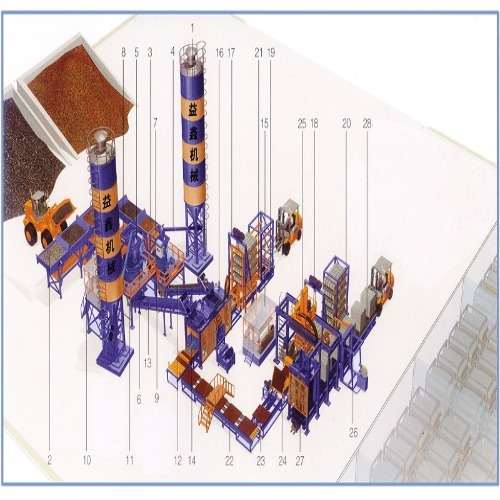
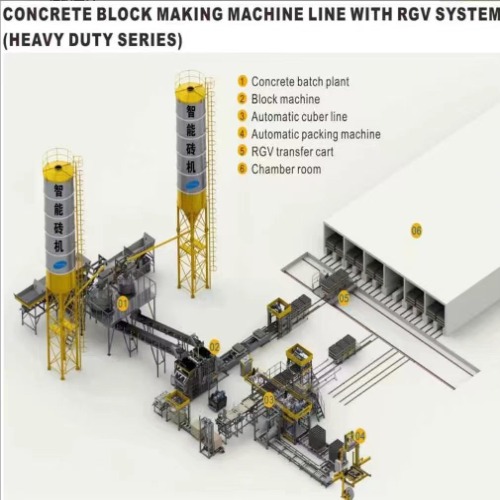
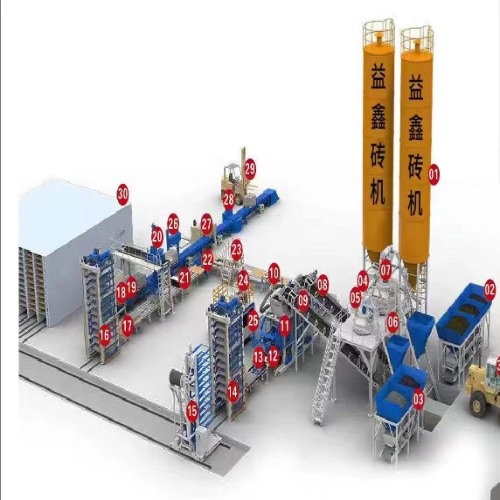
A concrete block production line is an integrated system of specialized equipment working in sequence. Understanding each component helps in making informed decisions about configuration and investment . Batching systems measure raw materials with precision, typically achieving ±1 kg accuracy. Modern batching plants feature 2 to 6 compartments with moisture sensors to account for material variations . Mixers blend concrete to consistent specifications. Twin-shaft mixers handle batch sizes from 1 to 4 m³ and are the standard choice for most block applications. Pan mixers are also recommended for semi-dry concrete used in block production . Block forming machines shape the concrete mixture into finished products. These machines combine hydraulic pressure and vibration to achieve optimal compaction. Advanced models feature PLC-controlled cycles with cycle times as low as 15 to 25 seconds . Stacking systems automatically arrange finished blocks onto pallets, reducing manual handling and protecting product integrity . Control systems orchestrate the entire process. A Programmable Logic Controller (PLC) with Human-Machine Interface (HMI) touchscreen allows operators to monitor production, adjust parameters, and store recipes for different products .
Phase 1: Pre-Planning and Site Assessment
The foundation of a successful block production line is rigorous planning. Before investing in equipment, you need to confirm market demand and site suitability. Conduct market analysis by researching local construction activity and competitor pricing. A typical plant requires demand of at least 20 to 30 m³ per day to justify investment. Identify which products are most sought after—hollow blocks, solid bricks, pavers, or curbstones—and analyze competitor pricing, which typically ranges from $70 to $160 per m³ . Select the site with careful consideration of long-term requirements. You need approximately 2 to 3 acres of industrial-zoned land with room for expansion. The soil should support at least 150 kN/m² bearing capacity for foundations. Confirm access to reliable 380V to 480V power, clean water supply, and good road access for raw material delivery and finished product transport . Secure permits early in the process. Apply for zoning approvals, environmental permits, and operating licenses. Factor in environmental impact assessments, which can take significant time to process .
Phase 2: Equipment Selection and Plant Design
With the site secured, focus on designing the layout and selecting equipment that matches your production targets. Design the plant layout to minimize material handling distances. Position aggregate batching machine plant where loaders can easily access them. Place cement silos close to weighing systems and dedicate space for truck loading with proper queue management. Route conveyors to keep material travel distances short . Select core equipment based on your production goals. Essential components include a batching machine with 2 to 6 compartments and moisture sensors, a mixer (typically twin-shaft for standard block production), a block forming machine with hydraulic system, stacking equipment, and a PLC-based control system . Consider automation level carefully. Semi-automatic machines suit startups and lower-volume operations with adequate labor availability. Fully automatic machines are ideal for high-volume production where labor costs are significant and consistency is paramount .
Phase 3: Site Preparation and Foundation
Clear and level the land to within ±25 mm, removing vegetation and debris. Pour reinforced concrete foundations to a depth of 300 to 400 mm using minimum C25 grade concrete, embedding anchor bolts for heavy production machines. Allow at least seven days for curing before installation. Install utilities including three-phase 380V to 480V power, water filtration and storage, compressed air at 6 to 8 bar, and telecommunications for control system integration .
Phase 4: Equipment Installation
Erect structural components including aggregate bins, cement silos, and access platforms. Position bins with sensors and vibrators for consistent batching. Mount mechanical systems including belt conveyors, screw feeders, dust collection units, and the mixer with its hydraulic systems. Finally, integrate the PLC control system, placing cabinets in climate-controlled rooms and connecting all sensors and actuators .
Phase 5: Commissioning and Testing
Before mass production, conduct thorough inspections. Check electrical connections, hydraulic and pneumatic pressures, and safety interlocks. Run dry testing without raw materials to verify conveyor alignment and cycle smoothness. Calibrate weighing scales with certified weights and program mix recipes into the PLC control system .
Phase 6: Trial Production
Produce small test batches using standard concrete mixes. Run slump tests and compressive strength tests to verify quality. Adjust water levels and mixing times as needed. Production should reach within 5% of design capacity with batching accuracy held within ±1% .
Phase 7: Training and Documentation
Provide comprehensive training for operators and maintenance staff covering automation systems, safety procedures, and preventive maintenance. Develop Standard Operating Procedures and maintenance schedules. Well-trained operators are essential for consistent quality and minimal downtime .
Phase 8: Compliance and Safety
Implement safety systems including personal protective equipment, lockout/tagout procedures, and environmental controls for dust suppression, wastewater recycling, and noise reduction. Compliance with environmental and safety regulations is essential for long-term operation .
Phase 9: Commercial Launch
Final inspections, certifications, and full-scale production launch. Begin tracking key performance indicators: output per shift, defect rates, energy consumption, and material waste .
FAQ
1.How long does it take to set up a block production line?
Typically 12 to 24 months, depending on project complexity, permitting, and automation level .
2.How many workers do I need?
Manual lines need 10 to 12 workers; semi-automatic lines need 8 to 10; fully automatic lines need only 3 to 5 .
3.How quickly can I recover the investment?
Fully automatic plants typically recover in 6 to 10 months through labor savings and higher output .
4.What equipment is essential?
A complete line includes batching machine, mixer, block forming machine, stacking system, and PLC control .
5.What mixer type is best?
Pan mixers are recommended for semi-dry concrete. Twin-shaft mixers are also suitable for most block applications .