Analysis of Applicable Models and Production Processes for Simple vs. Fully Automatic Brick-Making Lines
Sep 23, 2026
Introduction
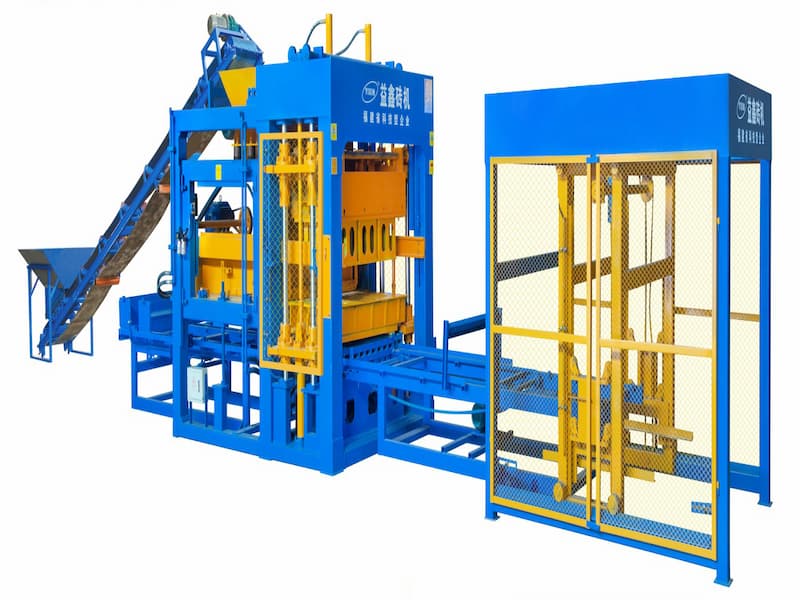
In the field of concrete block production, equipment selection directly determines the scale of investment, operating costs, and product flexibility. The QT8-15 block molding machine is a mature, mid-sized model currently on the market; the "8" indicates a capacity of eight 400×200×200mm hollow blocks per mold cycle, while the "15" signifies a molding cycle of approximately 15 seconds. Two configurations can be built around this core machine—a simple semi-automatic line and a fully automatic line—each suited to distinct operational scenarios.
I. Simple Production Line: A Low-Barrier Entry Solution
The simple line centers on the QT8-15 machine and operates with a basic setup comprising a JS750 forced-action mixer, a belt conveyor, a pallet feeder, and a brick-offloading device. The total equipment investment is approximately 350,000 RMB, requiring a footprint of around 200 square meters. The core logic of this setup is to replace automated stacking and pallet recycling processes with manual labor: mixed concrete is transported via conveyor belt to the machine's hopper, and molded green bricks are discharged by the offloading device before being transferred to the curing area by forklift or manual labor.
Regarding model selection, the standard QT8-15 unit suffices for this type of line. The standard unit produces blocks matching the raw material's natural color; producing colored bricks requires the addition of a color-facing component, which increases costs. The advantages of the simple line include low investment, rapid setup, and minimal technical requirements for operators. It is ideal for individual entrepreneurs or small building material plants entering the industry to serve local markets with standard and hollow bricks.
II. Fully Automatic Production Line: A Comprehensive Chain for Large-Scale Production
Building upon the simple line, the fully automatic line incorporates an automatic batching system, cement silos, screw conveyors, an automatic palletizer, and a pallet conveying system. Through PLC-based central control, it achieves full-process automation—spanning batching, mixing, and molding through to palletizing. Taking the QT8-15 fully automated line as an example, the production capacity over an 8-hour shift can reach 11,520 hollow bricks (400×200×200mm) or 60,480 solid bricks (240×115×53mm).
Automated lines are suitable for medium-to-large building material enterprises with stable sales channels. Key advantages include: first, the PLC control system allows for 30 preset production parameter sets, enabling real-time adjustments to vibration frequency and molding pressure based on material moisture and aggregate variations; second, the hydraulic system utilizes electro-hydraulic proportional valves to achieve a variable-frequency vibration mode—featuring low-frequency material feeding and high-frequency molding—thereby ensuring uniform product density; third, the combination of an automatic palletizer and a pallet recycling system reduces labor requirements to just 3–4 personnel.
Regarding model compatibility, the requirements for the host machine are the same for both simple and fully automated lines; however, it is essential to verify that the host machine is equipped with interfaces for automatic pallet feeding and palletizer control signals. Some manufacturers design their QT8-15 host machines with reserved communication ports for integration with automated lines, so technical specifications should be clearly defined during procurement.
III. Production Process: The Complete Path from Raw Materials to Finished Products
Whether using a simple line or a fully automated line, the core production process remains the same. In the raw material processing stage, cement is fed into the cement scale manually or via a screw conveyor, while sand and gravel are loaded into the batching machine by a loader; the PLC automatically weighs the materials according to the mix ratio. During the mixing stage, materials enter the JS750 forced-action mixer, where water is added and the mixture is blended until uniform. In the molding stage, the mixture is conveyed to the host machine's hopper; the mold descends onto a pallet, the feeding mechanism fills the mold cavity with material, and the brick is formed through vibration and pressure. Finally, in the curing stage, the molded green bricks are transported to the curing area by forklift or palletizer; they undergo natural curing for at least seven days and are ready for shipment only after meeting the required strength standards.
Conclusion
The choice between a simple line and a fully automated line is not a matter of which is superior, but rather which suits the specific operational scenario. A simple line allows for product and market validation with minimal investment, whereas a fully automated line entails higher investment in exchange for increased capacity and consistency. As a medium-sized host machine platform, the QT8-15 supports both configurations. It is recommended to make a choice based on sales radius, order stability, and financial status.
For more product details, please visit https://www.yxbrickequipment.com
Read More